Y-chromosome DNA (Y-DNA)
Y-chromosome DNA is almost entirely inherited exclusively from father to son. In theory, father and son should have an identical Y-chromosome, but random copying errors occur in nature. These errors cause the substitution of individual nucleotides (bases A, T, C, or G), which creates a new genetic variant or mutation.
Precisely these genetic variants are the basis for genetic genealogy. Because certain groups of men share the same mutations, they are classified into so-called haplogroups. When a geneticist confirms that at least two individuals share the same specific variant, a new branch on the global family tree is defined. Haplogroups are named with the letter of the main lineage (e.g., R, I, J...) and the code of a specific mutation (SNP), which represents a precisely defined point in the DNA chain where a change occurred (e.g., R-Y1392).
Y-DNA Haplogroup Tree
These genetic variants make it possible to construct a genetic genealogical haplogroup tree. An example of such a tree is the display of Paternal Lines (Y-DNA) on the Slovenian Genetic Atlas page.
Below is the Y-DNA haplogroup tree, where my oldest paternal ancestor is placed: Jakov Renka (b. approx. 1764, Ravna Gora).
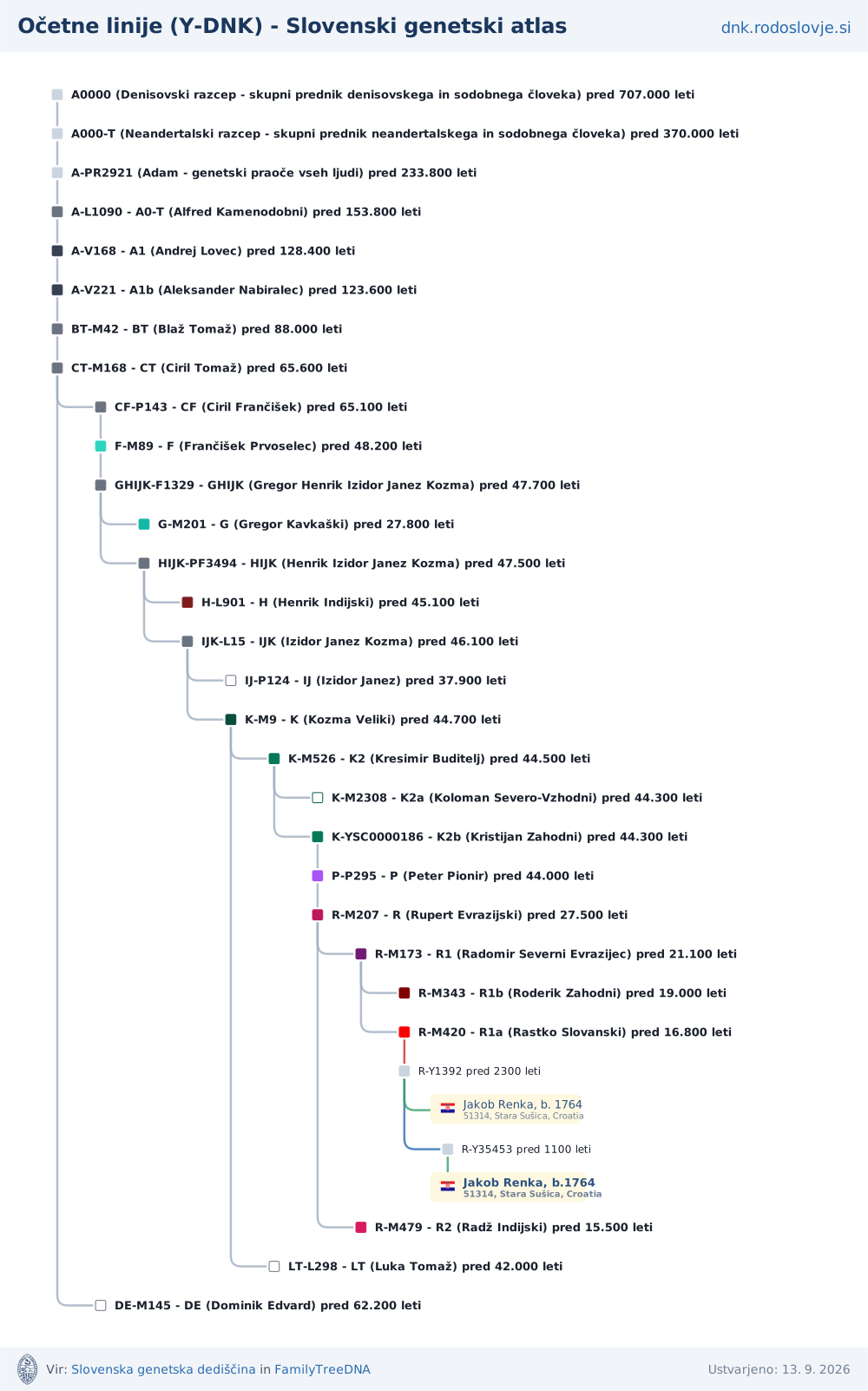
The first determined haplogroup was R-Y1392, estimated based on the atDNA test. It is an R1a branch with a common ancestor around 250 BCE and almost 2,500 tested descendants – it confirmed the Slavic origin of the paternal line, but it is too broad for genealogy.
A more precise analysis with the Big-Y 700 test at FamilyTreeDNA placed me in a significantly younger haplogroup R-Y35453. Its common ancestor, according to FTDNA's estimate, lived around 964 (95% confidence interval 272–1437), and according to an independent estimate by YFull (sample YF144004, YTree v14.05), about 1200 years ago – i.e., in the Early Middle Ages.
The tree structure around me (TMRCA estimates according to FTDNA Discover, 2026):
- R-BY32501 (approx. 417, interval 127 BCE–841) – the root of all lower branches with nine tested descendants from the Karst, Vipava, and Idrija edges of the Slovenian area and from Italy. FTDNA also attributes the archaeological sample I47066 (Akbari et al. 2026) to it – a person who died around 1170.
- → R-FT126611 (approx. 630) → R-Y136823 (approx. 780) → R-FT126969 (approx. 1765): Bandelj lineage, oldest ancestor b. 1750 in Gabrovica near Komen; one of the test subjects is a fellow genealogist at SRD.
- → R-Y35453 (approx. 964): Jakov Renka – me.
- → R-Y35450 (approx. 1770, interval 1394–1963): two test subjects with the surname Velikanje / Velikonja – the oldest known ancestors are Andrej Velikanje, b. 1755 in Idrija, and Matija Velikonja, b. 1685 in Predmeja near Ajdovščina.
YFull shows a broader context: our branch R-BY32501 is a Slovenian-Karst offshoot of the R-PH3782 lineage with a common ancestor around 400, whose current bearers stretch from Poland, Slovakia, and Hungary to Croatia and Slovenia – a picture we expect for lineages that came to our lands with the Slavic settlement.
Migration Path of My Ancestors
One of the most fascinating possibilities of Y-DNA testing is tracing migration paths from the so-called "Y-chromosomal Adam" to today. With the help of archaeogenetics (analysis of remains from archaeological sites), we can estimate where my ancestors moved throughout the millennia.
The video above shows the migrations undertaken by my paternal ancestors before they settled in the present-day area. These are therefore the "proto-Slavs" who brought their heritage in their genes to our lands (which Zoran Predin sings about in his famous song).
Searching for Paternal Relatives
Similar to autosomal tests, with Y-DNA we also look for matches with other test subjects. The difference is that a Y-DNA match means that two people share a common ancestor exclusively through the unbroken paternal line.
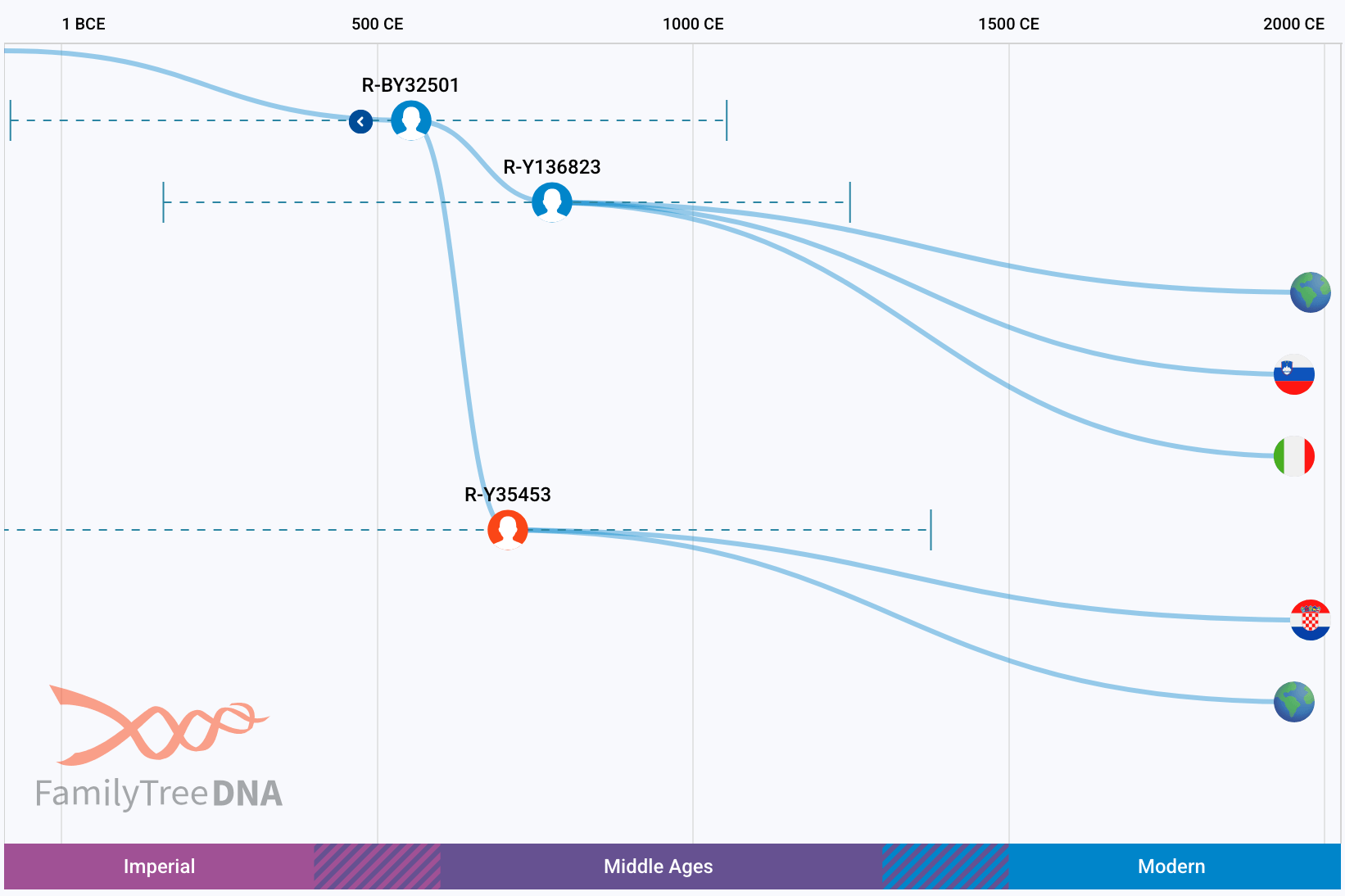
The closest matches are two test subjects from the Velikonja / Velikanje lineage from Idrija and Predmeja (today living in the USA). With them, I share a common male ancestor at the R-Y35453 level – about a thousand years ago – which roughly coincides with the period when the first permanent villages were formed on the western edge of the Slovenian area. Although we have different surnames, this is not unusual, as permanent family surnames became established in our country much later.
Big Y also showed how the branches are connected: the Velikonje have five private SNPs (R-Y35450), and I have 15 private variants that the Velikonje do not have. Renka is therefore not a younger offshoot of Velikonje, but both families are separate branches of the same, very old lineage. Interestingly, these two families found themselves as neighbors around 1800 in Ravna Gora in Gorski kotar and were even connected by marriage in the first generation – more on this in an upcoming article for Drevesa magazine.
At the R-BY32501 level (around 417), I share an ancestor with the Bandelj lineage and with several test subjects from Slovenia and Italy.
Private Variants (SNPs)
An important piece of information from the Big-Y test are the so-called private variants (Private Variants). These are mutations that are currently confirmed only in me.
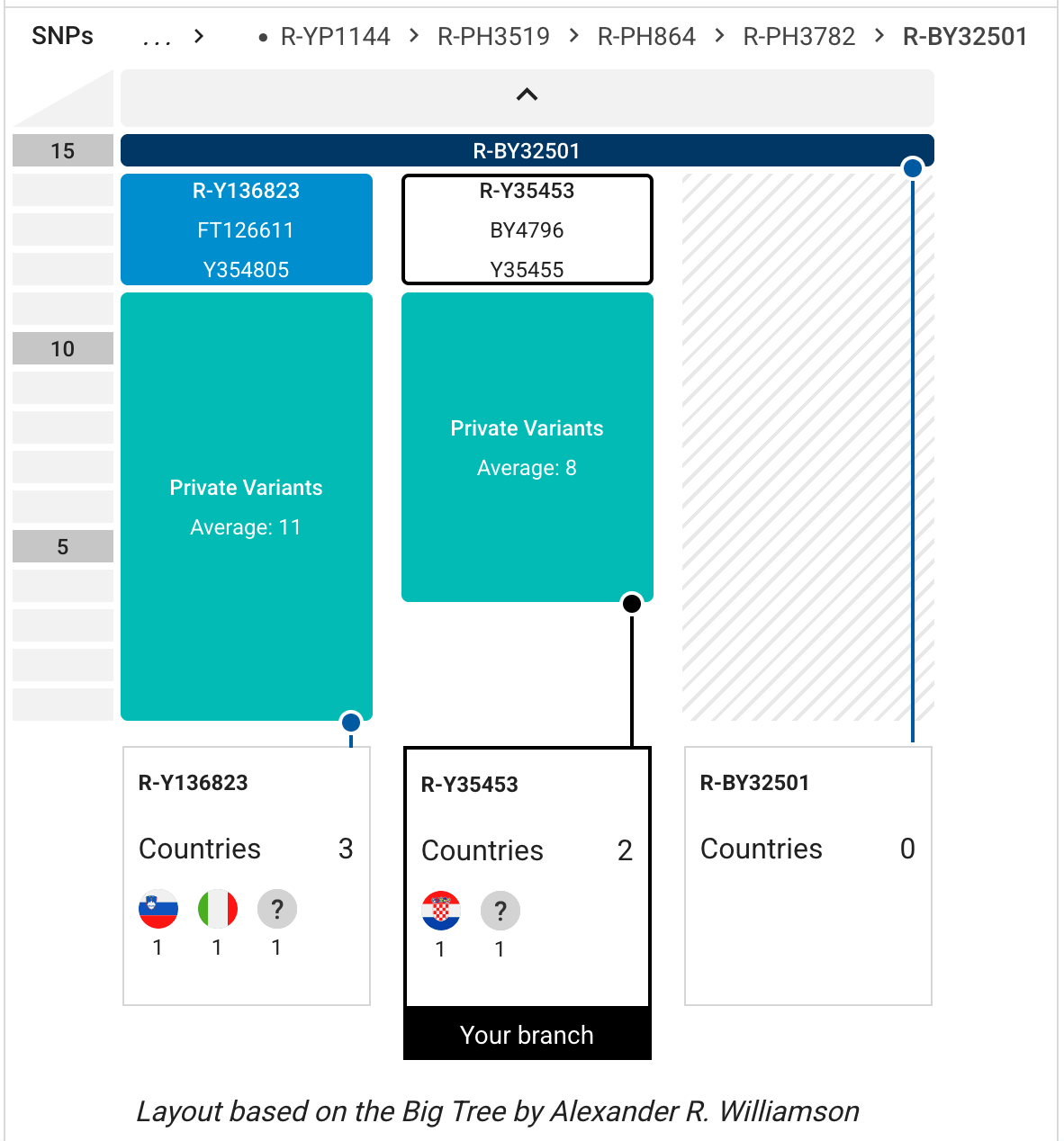
I currently have 15 private variants; for fourteen of them, the Big Y of another test subject (Velikonja) is reliably "ancestral," meaning they truly don't have them. Since a new mutation appears approximately every 80 to 100 years, these fifteen represent about a millennium of separate development from the Velikonje. Each of them is waiting for someone else with the same mutation to be tested, which would allow for the definition of a new, younger haplogroup.
Further Research
My next goal is to test the most distant male relative possible from the Renko/Renka lineage – a descendant of the collateral branches of Jakov Renka (Tomas b. 1827, Ignjat b. 1833, Jure b. 1837). His results would "transform" my private variants into an official haplogroup and bring the genetic tree closer to the period covered by the parish registers.
The surname Renko is found in Slovenia in four separate areas (Čepovansko and Trnovski gozd, Ilirskobistriško with Brkini, Zasavje, Gorenjska around Begunje); whether any of them share the same paternal line as the Renka from Ravna Gora would be shown by a Big Y test of a male from each of them – based on Y-matches from Idrija and Vipava, Čepovansko is the most promising.
I also wish to research other paternal lines in my tree (e.g., Rakar, Jekovec, Pezdirc). For these lines, I must first identify living male descendants and encourage them to test. For a start, a basic Family Finder or Y-DNA test (e.g., Y-37) would be suitable to confirm the lineage, followed later by a possible upgrade to Big-Y 700 for precise placement on the timeline.