Rakar
Alojzija Rakar, b. 1903 (my grandmother) died just a few years after my father's birth. Since very little oral history was preserved in the family due to her early death, researching the Rakar family presented one of my greatest genealogical challenges. I literally had to piece together the precious initial information from old family photos, notes from my father's aunt Antonija Rakar, b. 1908, and from the memories of my father's sister Pepca and cousin Štefka.
Despite the lack of information, within a few months I managed to piece together quite a rich tree of her ancestors:
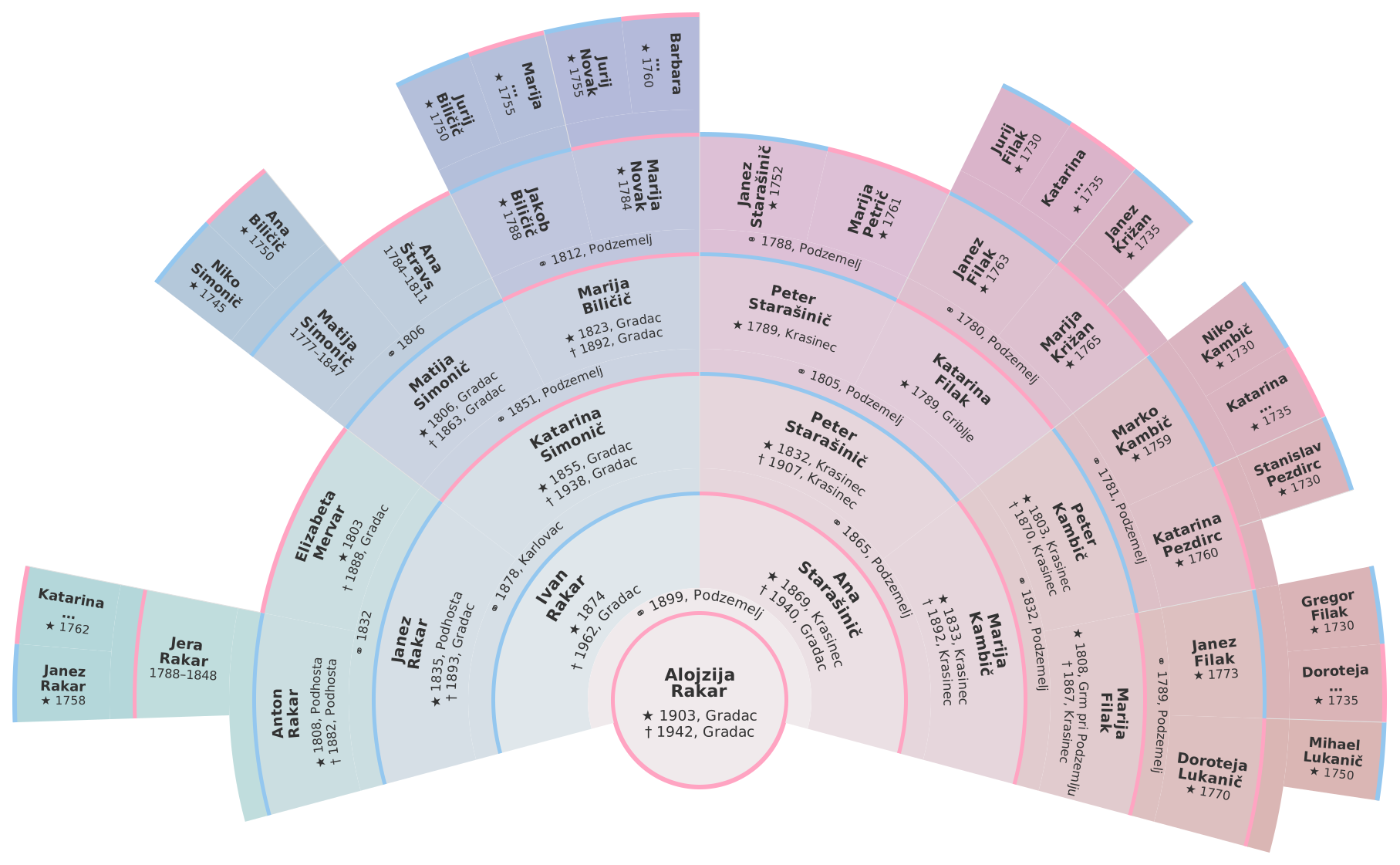
However, the path to these discoveries was a true detective story...
Initial problems and missing data
Already with Antonija's grandfather, Ivan Rakar, b. 1874, the research came to a halt. I simply could not find his birth in any of the parish registers of Podzemelj in Bela krajina, even though the family lived there. The birth year (1874) was only evident from his gravestone and marriage certificate. While browsing, however, I came across the birth certificate of Ana Rakar, b. 1885 in the village of Klošter, who could have been his sister, and a record of the marriage of widow Katarina Rakar, b. 1855 to Jurij Koplan.
That's when I remembered my aunt's words that we are related to the Koplans, but she didn't know exactly how. Unfortunately, searching for Katarina's first marriage (to an unknown Rakar) in the digitized books of the Podzemelj parish (Matricula Online) bore no fruit.
Key discovery in the archdiocesan archive
Due to this dead end, I decided to visit the Archdiocesan Archives of Ljubljana to check the Status Animarum (census of souls) for the Podzemelj parish. These censuses are invaluable for genealogists because, unlike parish registers, they show the entire family organized by individual houses. There, at the address Klošter 52 (where the widow Katarina lived at the time of her second marriage), I found an extremely interesting entry:
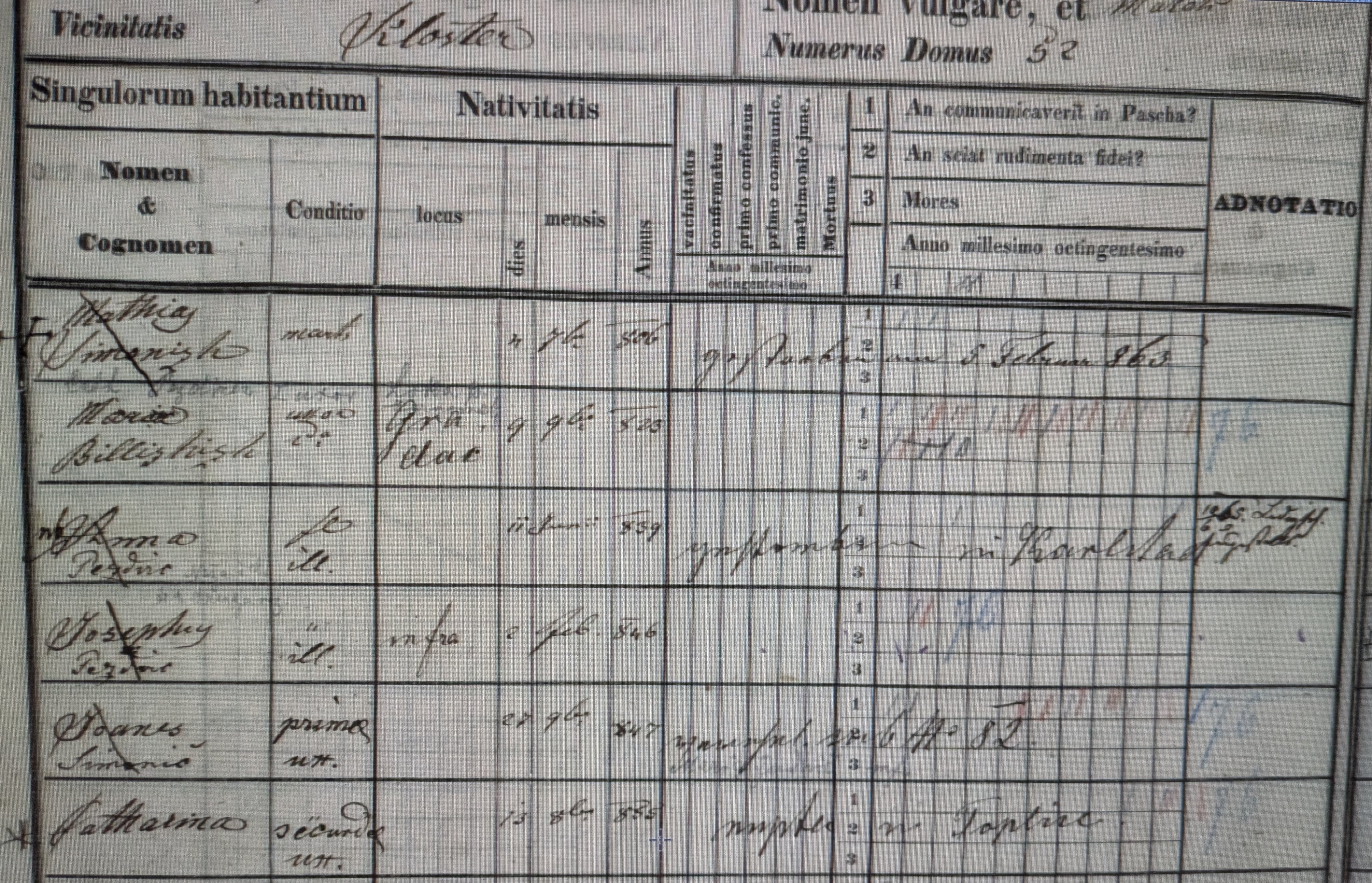
The entry revealed that Katarina, née Simonič, came from Dolenjske Toplice when she got married! Furthermore: her birth date (October 13, 1885) exactly matched the year of Katarina buried in the Koplan grave. This grave is located right next to the Renko family grave (where my grandmother Alojzija Rakar rests) – specifically to its left, while on its right side is the Rakar family grave (where Alojzija's father Ivan rests). Such a coincidence in the arrangement of graves in a cemetery is almost never just a coincidence!
On the adjacent page of the census of souls, another key piece of information was recorded in pencil (unfortunately without birth years):
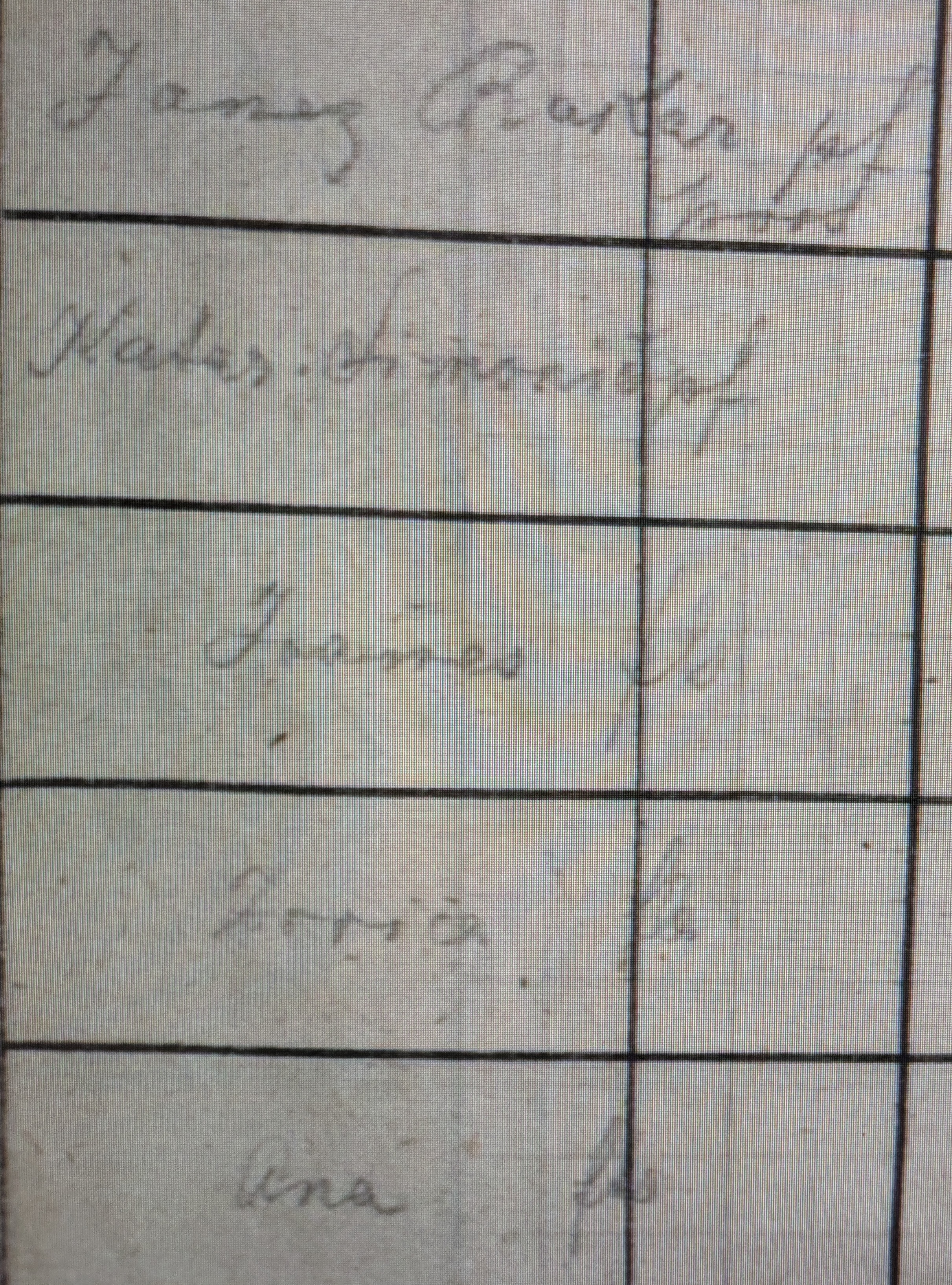
It became obvious that Katarina Simonič was first married to Janez Rakar and that they had three children: Janez/Ivan (the one I had been persistently looking for!), Zorica, and Ana. This simultaneously confirmed another of my aunt's stories – that two of her great-aunts had moved to America. Were these Zorica and Ana?
The next logical step was to research the Dolenjske Toplice parish.
The trail leads to Podhosta
The census of souls books for Dolenjske Toplice were not yet digitized at that time, so I had to examine the originals in the archive. Since I did not have an exact address to search, I simply turned page after page, looking for the surnames Rakar or Simonič. My effort paid off at house number Podhosta (Untergehak) 23:
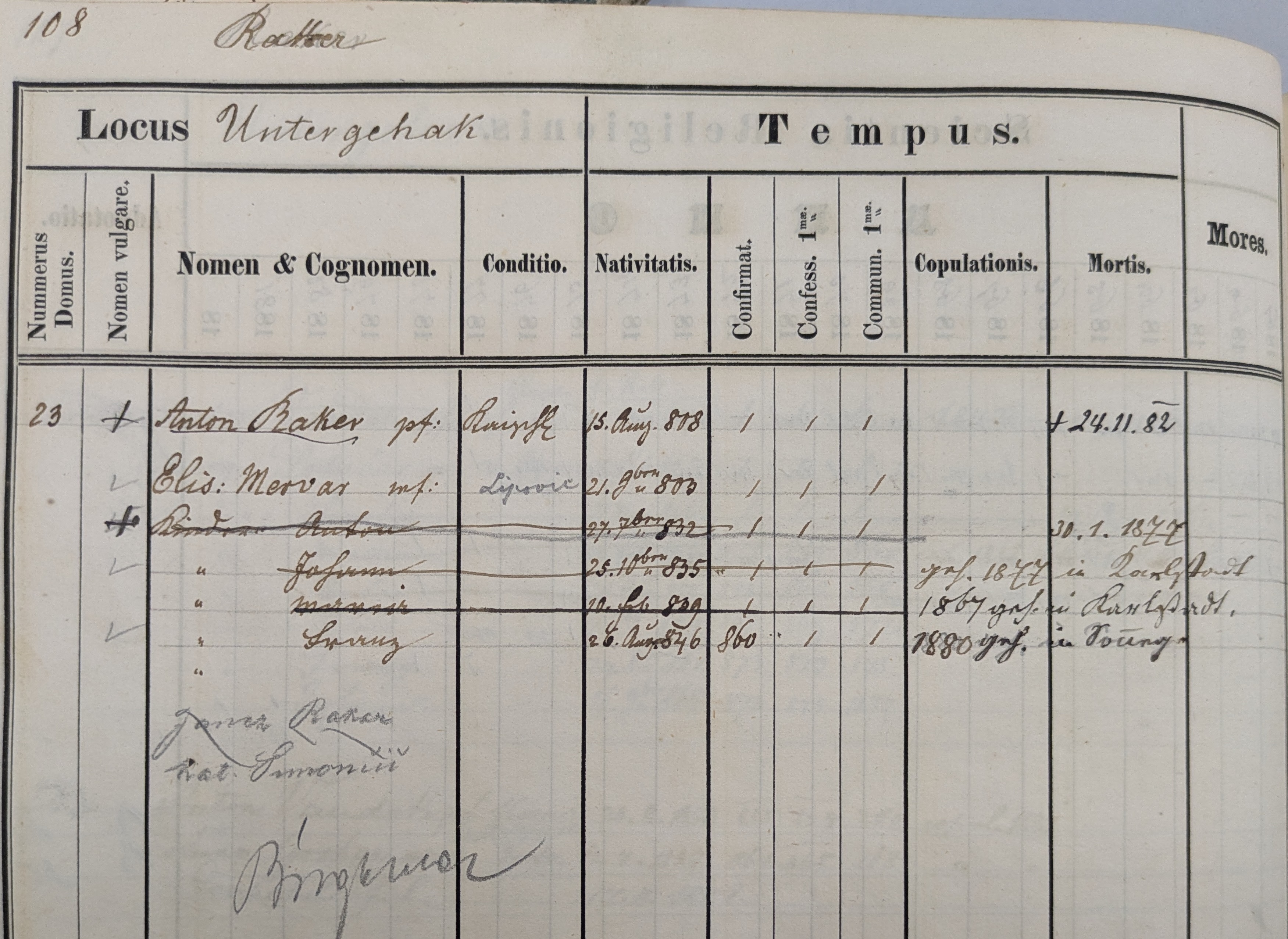
In the family of Anton Rakar, b. 1808, Janez Rakar and Katarina Simonič were added in pencil! Listed among Anton's children was son Janez, born October 25, 1835, who obviously married Katarina and lived with her at this address at least temporarily (hence perhaps the entry only in pencil). Next to it was a note that in 1877 he got married in a town that I read as Karlstadt (present-day Karlovac in Croatia).
Similarly, in the census for a nearby house, Podhosta 6, I quickly found Janez's mother Jera Rakar, b. 1783. Besides Anton, she had two more sons and two daughters – surprisingly, all were listed as illegitimate children, with no father recorded.
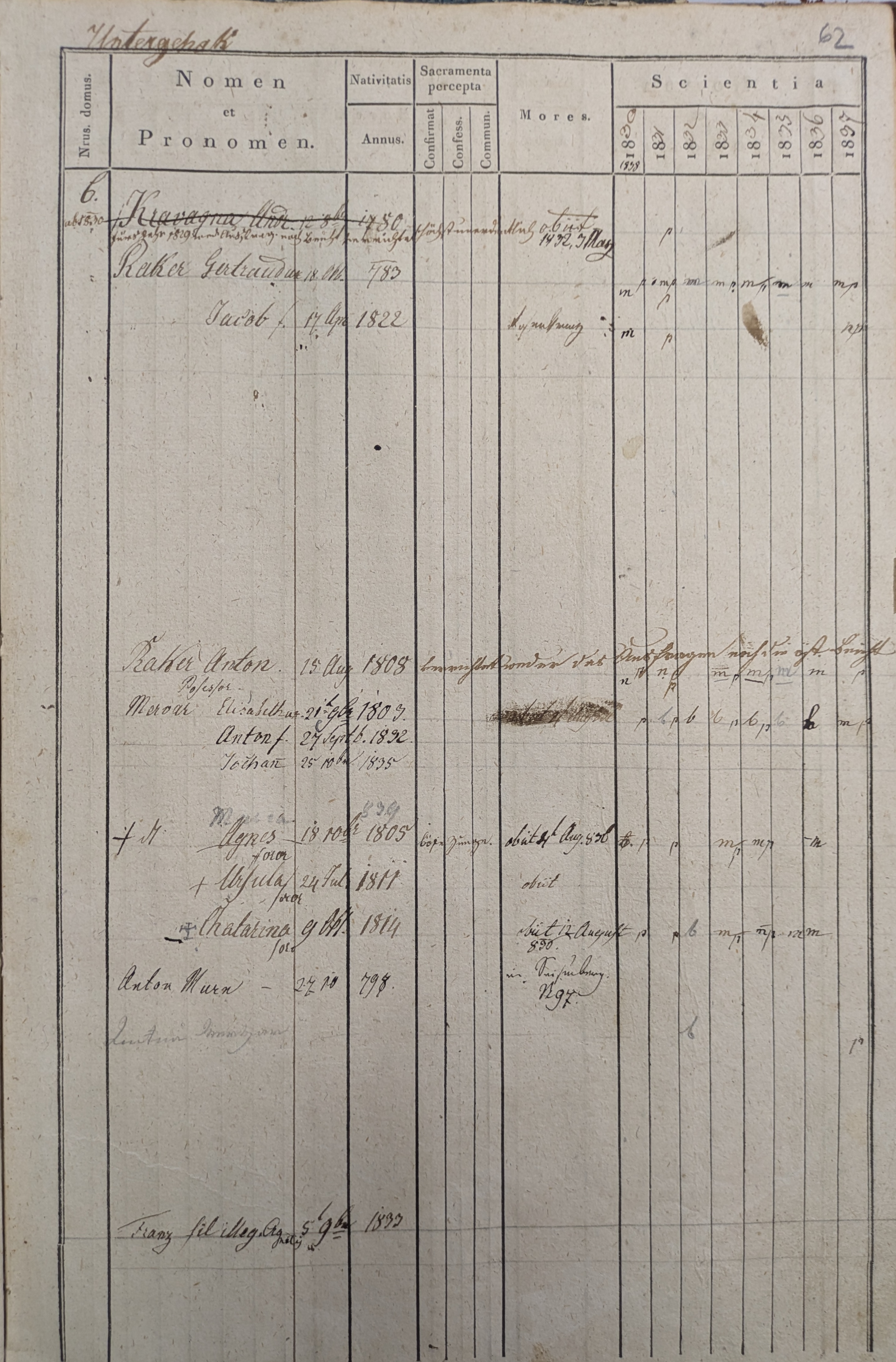
Jera Rakar apparently later married Andrej Kravanja, b. 1780 and in this marriage gave birth to another son, Jakob.
I found another illegitimate child of Jera, namely [Jožef Rakar, b. 1819], who died the same year. In this case, the father's name is explicitly written in the baptismal register: Franz Hirsch. Could it be possible that Franc Hirsch is also the father of her other illegitimate children?
Jump across the border: searching in Karlovac
Since I still didn't have an official confirmation of Janez and Katarina's marriage, and the birth records for their children (Ivan and Zorica) were also missing, I followed the "Karlstadt" hint and searched the Croatian books.
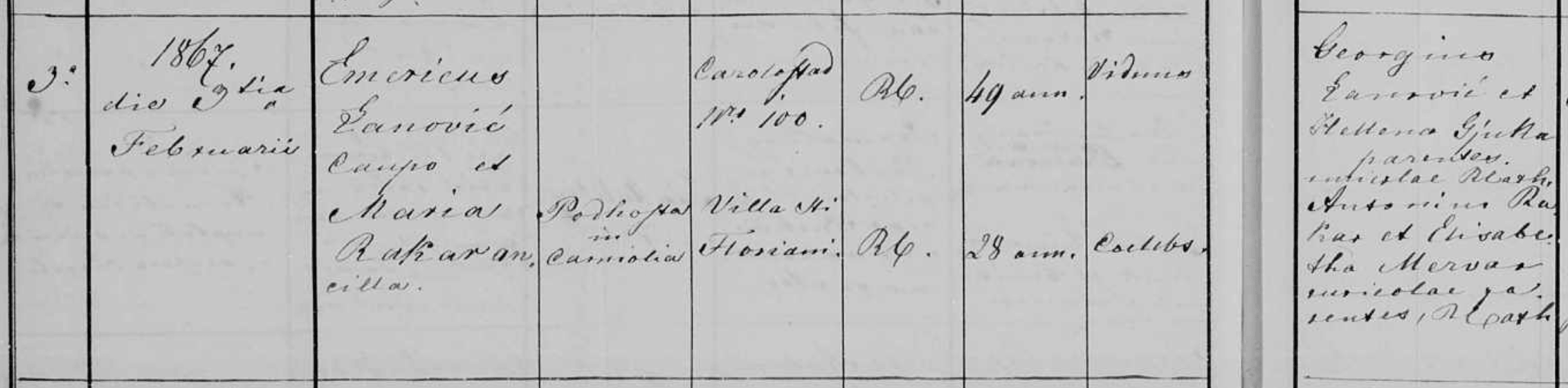
In the Karlovac parish of Dubovac, I first came across the marriage of Janez's sister Marija Rakar. As a servant, she married an innkeeper Mirko Banović:
I assume that Janez took refuge with his sister upon moving to Karlovac. With further searching, I finally found the birth of Zora Rakar (born February 16, 1878), daughter of Ivan (Janez) Rakar and Kate Šimonić:

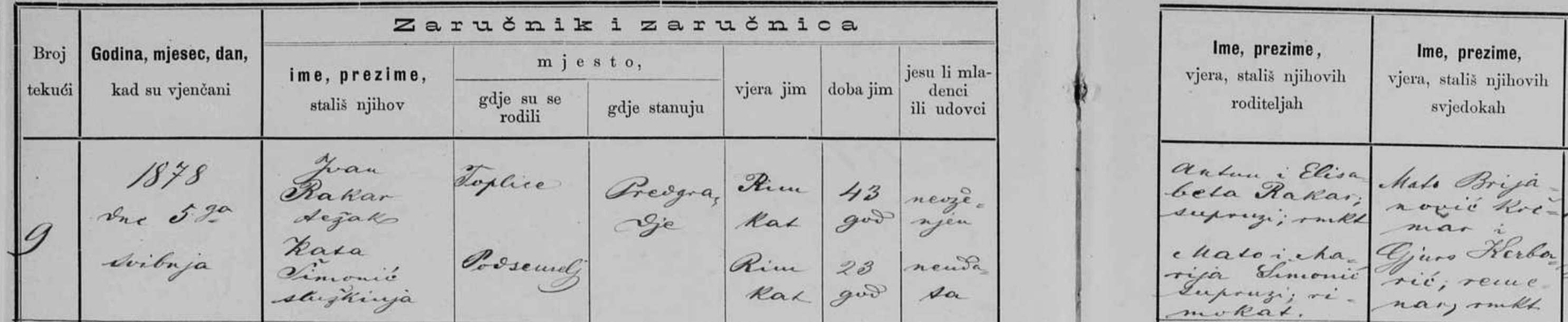
Her parents were not yet married at the time of her birth, which is also proven by a note in the book. Namely, they got married a few months later, exactly on May 5, 1878:
However, I hit a wall again with Ivan Rakar (born 1874). I cannot find his birth in the Dubovac parish, which leaves the possibility that he was born in another surrounding parish.
American dream: relatives across the pond
As previously mentioned, family tradition dictated that two of Ivan's sisters had moved to the United States of America. The older sister, Zora Rakar, was renamed Rose in America. Although I have not yet found an exact record of her first arrival (presumably around 1890), her later traces in the USA are well documented.
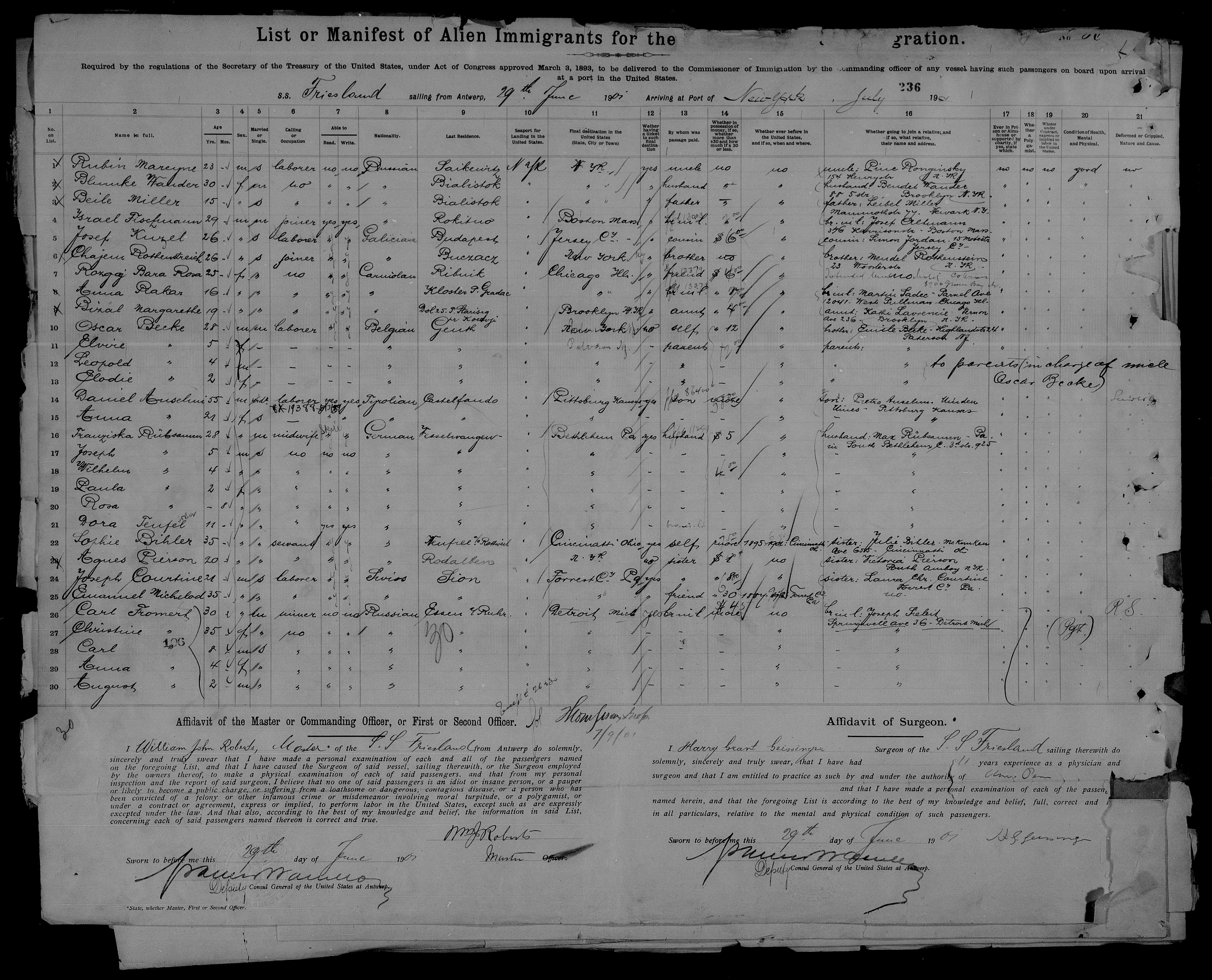
A few years later, in 1901, the younger, then 16-year-old sister Ana Rakar set off to join her. From her immigration document (in the 8th row), it is clearly visible that she traveled to her brother-in-law, Martin Sodec (Zora's husband).
Through research, I have successfully discovered numerous descendants of Rose (Zora) Sodetz in the USA, as well as some descendants of Ana Okorn.
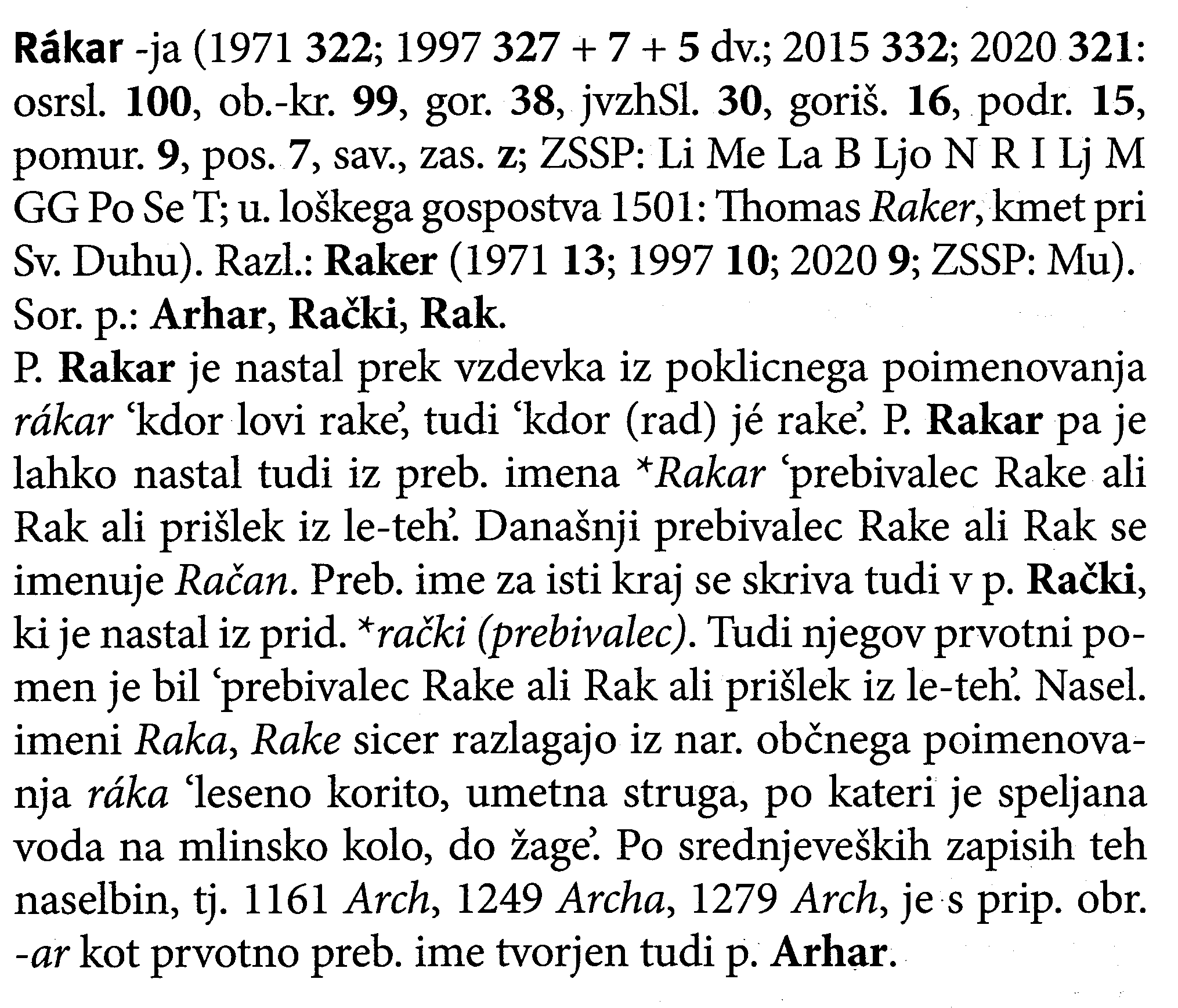
Surname Rakar
From the book Leksikon priimkov (Janez Keber, 2021):
Plans for further research
Although I have unraveled the mystery of the Rakar family quite a bit, a few interesting questions remain open:
-
Birth record of Janez/Ivan Rakar (link):
- One possibility is that he was born in one of the neighboring parishes around Karlovac, or perhaps even somewhere in Bela krajina or Dolenjska.
- Most likely, it will be necessary to delve into the censuses of souls (Status Animarum) of individual parishes.
-
Origin of Elizabeta Mervar (link):
- According to current data, she was supposed to originate from Lipovec, but so far I have not been able to find her in the local parish books (Semič parish) and in surrounding parishes.
-
The mysterious Jera Rakar (link):
- Her exact birth date and place are not yet fully confirmed. I currently have an eye on an entry from the birth register of January 27, 1788, but at her death on July 10, 1848, it says she was 65 years old (which would mean a birth year around 1783).
- Jera had four illegitimate children (who all bear the surname Rakar), one child with Franc Hirsch and one with Andrej Kravanja. It would be interesting to find out more about the biological father of her remaining children, for which there are currently no traces.
-
Origin of Franc Hirsch (link):
- I currently have no other information about him, other than the fact that he is listed in the parish register as the father of one of Jera's illegitimate children.
-
Genetic test of a male Rakar descendant along the Y-DNA paternal line:
- So far, I only know of one living male descendant on the direct Rakar paternal line. With a Y-DNA test, it might be possible to track down the biological father of the illegitimate children and thus confirm or refute a potential biological connection with Hirsch or Kravanja.